github.com/jamescook/tryst-range-slider
0.1.0 / published Sep 1, 2026 / repository
A dual-thumb range slider for tryst - two draggable thumbs bounding a [low, high] range on one rounded track, with an accent-filled segment between them. Built on Tryst::OwnerDrawnWidget and rendered through tryst-vector.
tryst-range-slider
A dual-thumb range slider for tryst, Crystal's Tcl/Tk binding —
two draggable thumbs bounding a [low, high] range on one rounded
track, with an accent-filled segment between them (not from an edge,
unlike a single-thumb slider). Built on Tryst::OwnerDrawnWidget and
rendered through tryst-vector.
require "tryst"
require "tryst-range-slider"

app = Tryst::App.new
slider = Tryst::RangeSlider.new(app, min: 0.0, max: 500.0, step: 5.0,
  low: 50.0, high: 350.0, format: ->(v : Float64) { "$#{v.round.to_i}" })
slider.pack(fill: "x", padx: 16, pady: 8)

slider.on_action { |(low, high)| puts "price now $#{low.round.to_i}..$#{high.round.to_i}" }

app.show
app.mainloop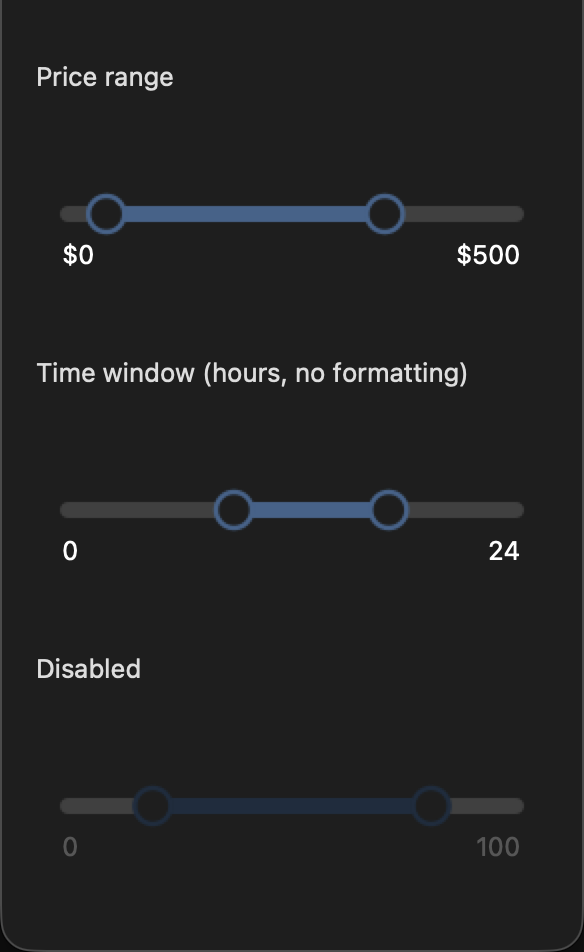
From examples/range_slider_demo.cr.
#pack/#grid place it, #low/#high read the current bounds,
#low=/#high=/#set_range set them programmatically, #on_action
fires on every user-driven change (drag, click-to-position, or
keyboard) but never for a programmatic set — the same split every
other stateful widget in this codebase draws. Prefer #set_range over
calling #low= and #high= separately when moving both bounds at
once: setting them one at a time clamps the new value against the
other thumb's still-old position, which can give a surprising result
when shifting the whole window (e.g. [10, 20] to [40, 60]) rather
than just narrowing or widening it.
The two thumbs can never cross. min_gap: (defaults to step:) is how
close they're allowed to get — dragging or nudging one past the other
just stops it min_gap away rather than swapping which is low and
which is high.
Keyboard
Tab to the control, then:
- Left/Right/Up/Down — nudge the active thumb by
step - Shift + arrow — nudge by 10×
step - Home/End — jump the active thumb to its own bound (
minfor low, or as close tomaxasmin_gapallows; the reverse for high) - Tab — while the low thumb is active, moves to the high thumb without leaving the widget; press it again once the high thumb is already active to move on to whatever's next
Only one thumb is "active" for the keyboard at a time (shown by the
focus ring) — click either thumb to make it active, or Tab to switch.
This is a deliberate difference from a web <input type="range"> pair,
which gets one independent Tab stop per thumb: a plain Tk widget is
opaque, so there's no way to lay a second focusable widget over a
thumb without covering the antialiased circle drawn beneath it. One
real Tab stop for the whole control, with an internal active-thumb
pointer, is what actually renders correctly here.
Requirements
Whatever tryst and tryst-vector need - Crystal >= 1.21.0, Tcl/Tk 8.6, and ThorVG >= 1.0 (see tryst-vector's own README for per-platform package names and why).
Examples
crystal run examples/range_slider_demo.crTests
shards install
crystal spec                    # host
scripts/docker-test.sh          # Debian forky, same suite
scripts/docker-test.sh builds from this repo's own root; shards install inside the image fetches tryst and tryst-vector directly via
their github: dependencies. It takes the same arguments crystal spec does, so a focused run works there too.
API
- Tryst
The Tcl-major-version auto-detection probe (TCL_VERSION=8/9 forces a choice; anything else auto-detects - see interp.cr's header comment for the full policy and why this needs to be a shell probe at all) used to be hand-copied verbatim at every {% if %}/{% unless %} site that needs it: twice in interp.cr, once in event_source.cr.